

Saturday, 30 June 2012
Sam's Birthday

Saturday, 23 June 2012
Need To Shave!

Saturday, 16 June 2012
Haw Arr Yoo

Things just keep happening to me.
Note for the folks at home: "Father" isn't an uncommon title to be called in rural Kenya, as a Caucasian male. For a few decades following the exit of the colonial British government in the mid-1900s, the only white people to make it out to "the bush" were (nearly) all missionaries. The habit of referring to white males as "Father" (meaning "priest"), it seems, is not one to die quickly. Religion is an integral part of the cultures of rural Kenya, but outsiders might be surprised to hear that Christianity and Islam are, almost universally, the only religions practiced. The historical religious beliefs of Kenyan peoples, even among the most traditional tribes, have long since been adjusted to fit within a Christian or Islamic system.
Saturday, 9 June 2012
Guest True Story 3

Note for the folks at home: The Kanga; also known variously as the leso ("lay-so"), kikoi ("kee-koy"), or shuka ("shoo-kah"); is an extremely common garment throughout Kenya. Generally considered the "traditional" counterpart to the more "western" outfit of trousers and shirt, a kanga is a rectangular sheet worn by wrapping around the body of a woman or man. Although a kanga about the waist is often paired with a western-style shirt, kangas can be worn by themselves (in which case several are needed, wrapped around waist, torso, shoulders, etc.) Kangas have numerous uses outside of clothing: baby papoose, blanket, plyable basket, towel, wall hanging, etc., etc., etc., ad infinitum.
Saturday, 2 June 2012
Editorial Cartoons

Saturday, 26 May 2012
Kisamburu Lessons

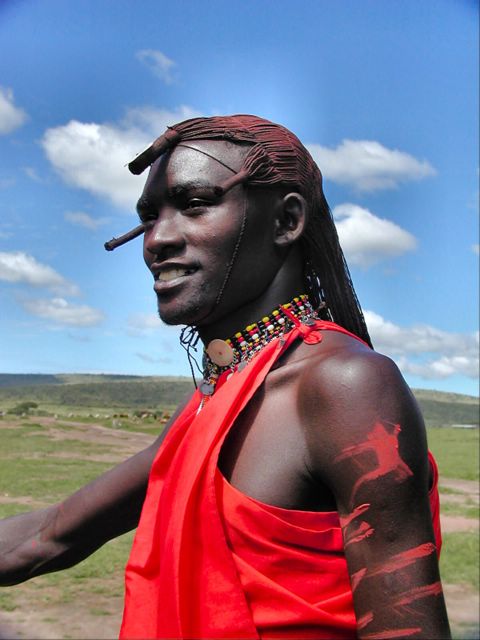
Note for the folks at home: Kisamburu, which we've already discussed, is the "mother tongue" of the local inhabitants of Maralal, the Samburu people. The language is very unlike the more widespread Kiswahili, simply because Kisamburu and Kiswahili are from completely different linguistic roots --- they were literally brought into the country by two completely different groups. Kiswahili, as it is based partially in Bantu language roots, came to Kenya with the Bantu ethnic group through their great migration from West Africa several thousand years ago. Kisamburu, however, has Nilotic roots. The Nilotes came into Kenya from the North, through Sedan. Another Kenyan tribe of the Nilotic ethnic group is the Maasai. The Maasai people are often considered "cousins" to the Samburu people, as both groups share a great deal of cultural traditions. (They are even often confused in photographs, because the dress of the two peoples can appear so similar. Note: a Samburu man and a Maasai man.)

Saturday, 19 May 2012
Vumbi!

Note for the folks at home: The Samburu district, with its semi-arid environment, generally lives up to its "desert" reputation... except during the (sudden, unexpected) rainy seasons. I suppose "unexpected" isn't fair, as it happens every year, but the rainy seasons (a long one from April-August, another short one from October-November) will undoubtedly surprise the newcomer who's accustomed himself to the hot, dry, dusty days of the dry season. Otherwise clear, glaring skies become battlegrounds for armies of raging thunderheads; the scorched, grey sand gives way to treacherous mud swamps; the normally painful direct sunshine is replaced by an equally painful barrage of ice-cold raindrops the size of grapes. Oh, and plants grow and stuff.
Subscribe to:
Posts (Atom)